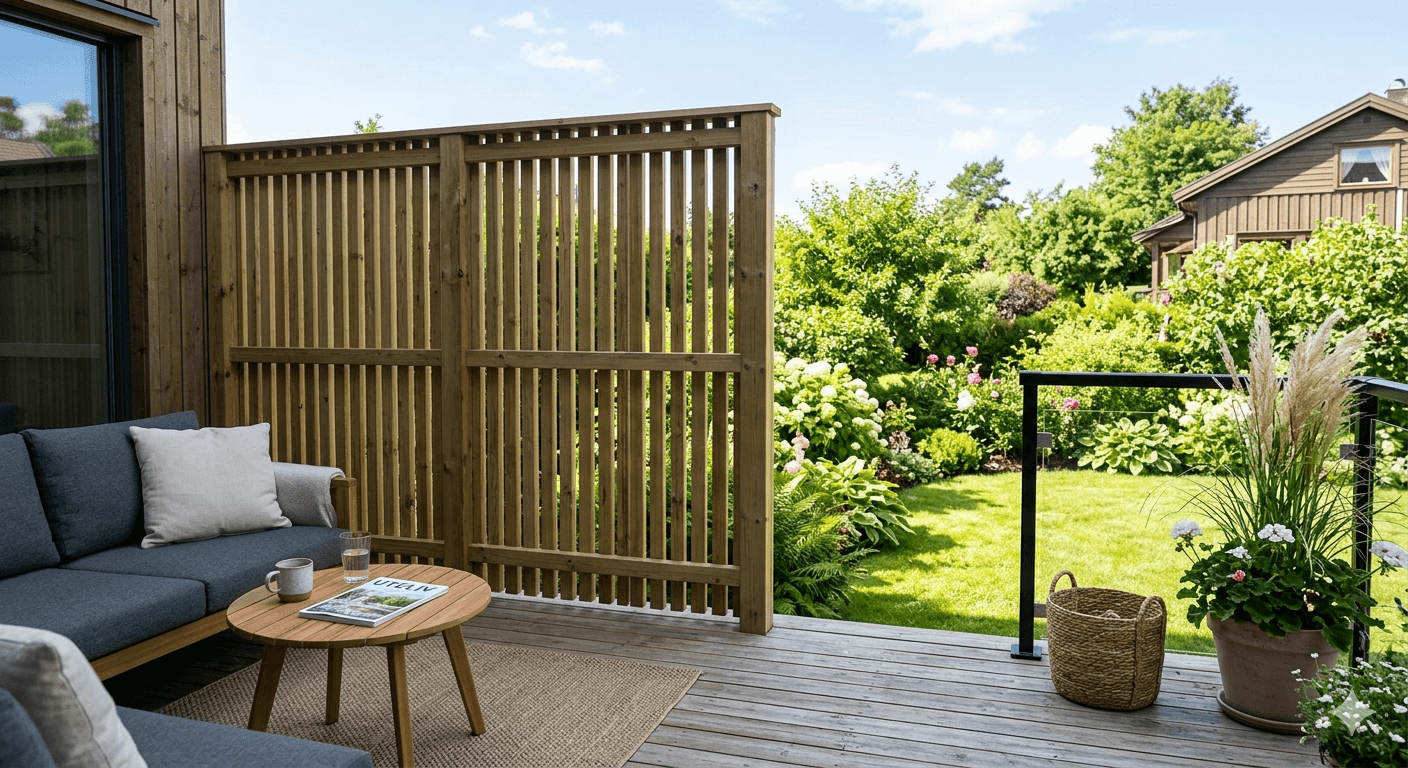
An outdoor slat wall can provide screening, light, and a lighter expression than a fully closed privacy wall. That is exactly why slats are a popular option for patios, outdoor seating areas, and boundary edges. But before you start measuring and ordering material, it helps to understand which rules actually apply.
This article summarizes when a privacy screen can typically be built without an application, what matters near a property boundary, and which practical checks are still worth making before you build.
What counts as a privacy screen?
A privacy screen is a screen wall intended to reduce wind, weather exposure, noise, or direct visibility. An outdoor slat wall will often serve exactly that purpose, even if it feels lighter and more open than a solid screen.
That means the rules are influenced not only by the material but also by the function and placement.
When can you build without applying?
The Norwegian source article explains that, for many residential properties in Norway, a privacy screen can often be built without an application if it stays within specific limits.
If the screen stands at least 1 meter from the property boundary:
- it may be up to 10 meters long
- it may be up to 1.8 meters high measured from the ground
If the screen stands closer than 1 meter to the property boundary:
- it may be up to 5 meters long
- it may still be up to 1.8 meters high measured from the ground
The screen may be freestanding or attached to a building.
What should you still check?
Even if the privacy screen may be exempt from an application under Norwegian rules, that does not mean you can build without checking anything else.
Four things are especially worth reviewing:
- municipal plans and zoning rules: local plans may impose their own limits on height, placement, or design
- distance and terrain: height is measured from the ground, so sloped or altered terrain can affect the assessment
- multiple screens combined: one screen per boundary may be treated differently than several combined structures
- roads or sight lines: heavier or denser screens near roads may affect visibility and require closer review
If you are uncertain, the safest approach is to check with the local municipality before building.
How close should the slats be in a privacy screen?
When you build a privacy screen with slats, the choice is not only about style. The spacing also controls how much visibility, wind, and light passes through the wall.
As a rule of thumb:
- tighter spacing gives more privacy
- wider spacing gives a lighter expression and more daylight
- in exposed areas, a fully closed screen may take more wind load than a more open slatted wall
If you want to go deeper into this, see our article on typical spacing between slats.
Practical tips before you build
Before ordering materials, think about more than height and length.
Some simple guidelines:
- choose materials suited to outdoor use
- finish the slats correctly before installation if they are not pre-finished
- allow for wind load when planning posts and fasteners
- measure the full run carefully before estimating the slat count
- buy a little extra for cuts and adjustments
If you are still weighing indoor versus outdoor requirements, you may also want to read indoor vs. outdoor slat walls.
Summary
A slat wall used as an outdoor privacy screen can often be built without an application, but only if it stays within certain dimensions and follows the rules that apply to the property.
The most important things to check are:
- the height of the screen
- the total length
- the distance to the property boundary
- any local planning restrictions
- whether the location affects road visibility or sight lines
Before you build, use our slat wall calculator to estimate how many slats and how much total length you need for either a decorative wall or a practical outdoor screen.